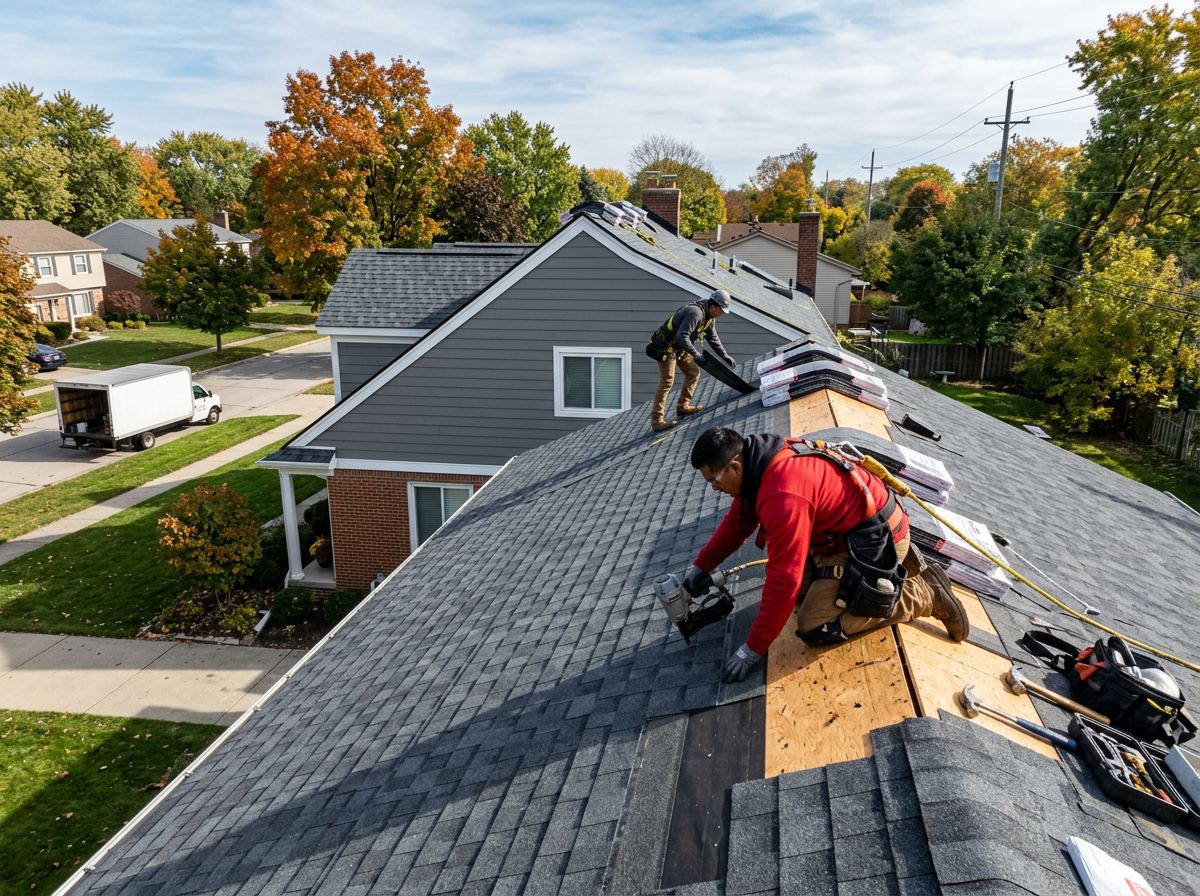
Troy homes built between the 1960s and 1990s often carry second or third asphalt roofs that show granule loss and curling shingles after repeated freeze-thaw cycles. Ice dams form along eaves during cold snaps, forcing water under existing layers while wind-driven rain exploits weak valleys and step flashing. Mature trees near neighborhoods like those around Oakland Mall drop debris that accelerates wear on south-facing slopes.
We begin every job with a full tear-off to expose the decking, checking for rot or delamination before installing new underlayment and ice and water shield along eaves and valleys. Drip edge goes on all perimeters, pipe boots are replaced at penetrations, and architectural shingles are laid with proper nailing patterns. Ridge vent and soffit intake are balanced to reduce attic moisture that contributes to future ice dam formation.
Subdivision rules in southeast Oakland County often limit color choices and require matching existing profiles on colonials near Big Beaver and the Somerset Collection. Wind exposure on open lots near Rochester Road Corridor demands six-nail fastening and reinforced valleys. We coordinate gutter work during the same visit so runoff is directed away from foundations before the next winter cycle begins.
Technician insight
In Troy, the thing that catches most people out with Architectural Shingles is hidden plywood rot along the eaves on 1980s colonials near the Troy Historic Village. Ice dams push water under the old underlayment year after year, and homeowners only notice when ceilings stain. We always pull the gutters during tear-off so we can see the true edge condition before quoting.
Ice Dam Leak on a Rochester Road Colonial
Water stains appeared on second-floor ceilings after a January thaw. Tear-off revealed saturated decking and failed step flashing where two valleys met. We replaced the damaged plywood, installed full ice and water shield coverage, and laid new architectural shingles with reinforced valleys. No further leaks occurred the following winter.
Architectural Shingles Services We Offer
✓Architectural Shingle Tear-Off
Complete removal of existing layers reveals decking condition so new shingles lie flat and last through Troy winters.
✓Ice and Water Shield Installation
Self-adhering membrane applied at eaves and valleys blocks water intrusion from ice dams common along Rochester Road Corridor.
✓Ridge Vent and Soffit Intake Upgrade
Balanced ventilation reduces heat and moisture buildup that accelerates shingle aging on 1970s and 1980s ranches.
✓Valley and Step Flashing Replacement
New metal flashing at roof intersections prevents leaks where wind-driven rain concentrates on Troy colonial homes.
✓Decking Assessment and Repair
Rotten or soft plywood sections are replaced during tear-off to create a solid base for architectural shingles.
How it works
- 1
On-Site Roof Evaluation
We walk every slope to note granule loss, curling edges, and signs of past ice dam leaks before any work starts.
- 2
Full Tear-Off and Decking Check
Existing shingles and underlayment are removed so the deck can be inspected for rot caused by repeated freeze-thaw cycles.
- 3
Underlayment and Shingle Installation
Ice and water shield, drip edge, and architectural shingles are installed with correct nailing and flashing details.
- 4
Final Ventilation and Cleanup
Ridge vent and soffit intake are verified, gutters are cleared, and all debris is removed from the property.