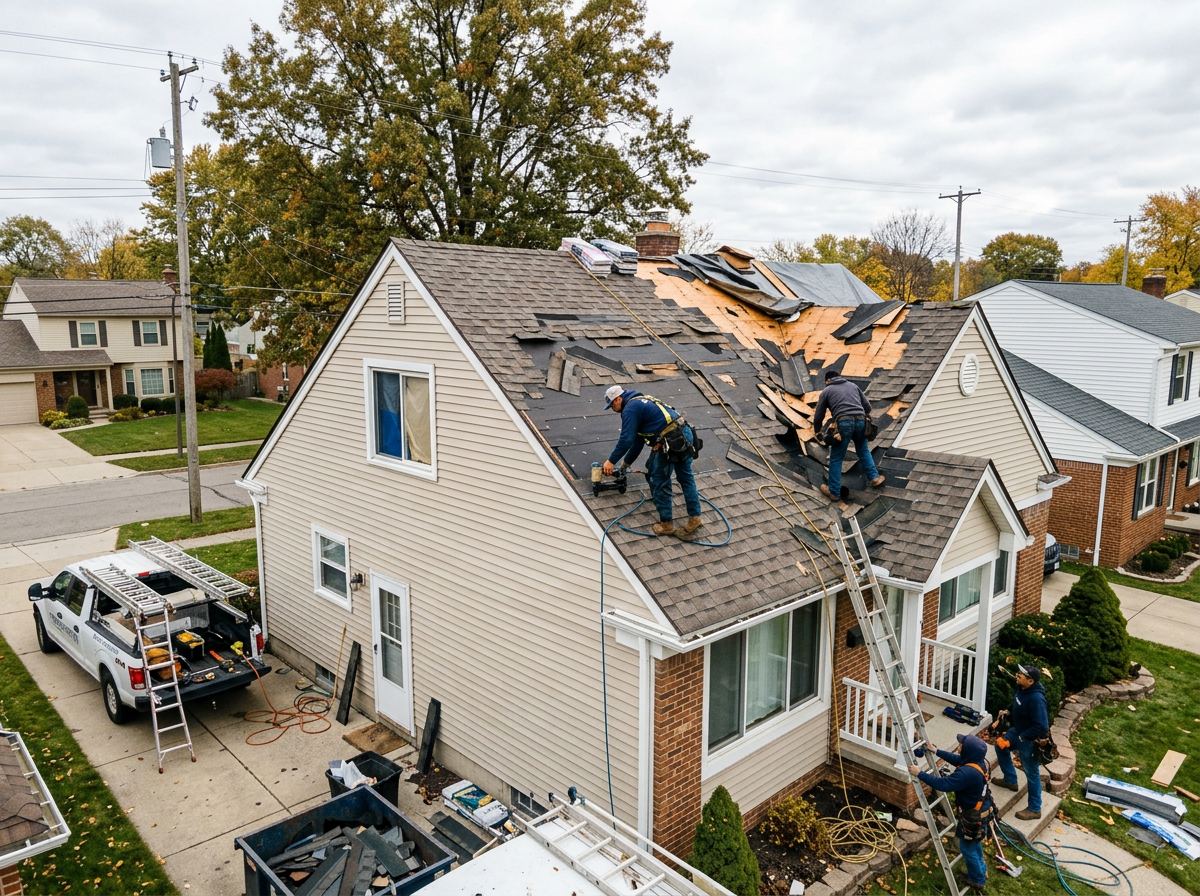
Strong winds along the Rochester Road Corridor and near Somerset Collection often lift architectural shingles on second and third roofs of 1960s-1990s colonials and ranches. Mature trees drop limbs that tear underlayment and expose decking, while repeated freeze-thaw cycles turn small gaps into ice dams that push water under step flashing and valleys. Homeowners notice granule loss and curling shingles first, especially where HOA rules limit visible repairs.
We start every job with a top-to-bottom inspection that checks ridge vents, soffit intake, pipe boots, and drip edge for wind-driven displacement. Tear-off proceeds only where wind has compromised layers; we replace damaged decking, install ice and water shield in valleys and eaves, and reinstall matching architectural shingles with proper step flashing. Work stays confined to the affected slopes so the rest of the roof remains untouched.
In southeast Oakland County subdivisions, wind damage frequently appears after storms that also affect Birmingham, Royal Oak, and Rochester roofs. We document every lifted shingle and displaced flashing with photos for insurance adjusters, then complete repairs that restore the roof's ability to handle the next round of wind, hail, and ice.
Technician insight
In Troy the thing that catches most people out with wind damage is how often the real problem sits under the second layer of shingles on 1980s ranches near Oakland Mall; the wind lifts the top course but the ice dam that formed last winter has already rotted the decking underneath, so you end up doing more deck work than the surface damage suggests.
Wind-Lifted Shingles on Big Beaver Colonial
A Troy colonial near Big Beaver had several courses of shingles lifted after a spring storm. We found the underlayment torn and decking soft along the north valley where mature trees had funneled wind. We performed a targeted tear-off, replaced the damaged decking, installed new ice and water shield, and reinstalled matching shingles so the roof blended with the rest of the house.
Wind Damage Services We Offer
✓Architectural Shingle Replacement
We replace wind-lifted or torn architectural shingles on individual slopes while matching existing granule color and texture.
✓Valley and Step Flashing Repair
Damaged valleys and step flashing around chimneys and walls are cut out and reinstalled with new metal to stop wind-driven water entry.
✓Ridge Vent and Soffit Intake Restoration
Wind can dislodge ridge vents or block soffit intake; we reseal or replace these components to maintain proper attic airflow.
✓Drip Edge and Pipe Boot Replacement
Wind often pulls drip edge away from the fascia and loosens pipe boots; both are replaced during the same visit to seal the roof edge.
✓Decking Repair After Wind
When wind-driven debris punctures decking, we remove the damaged sections and install new plywood before underlayment and shingles go back on.
How it works
- 1
Site Walk and Documentation
We examine every slope, note wind entry points, and photograph granule loss, lifted shingles, and displaced flashing for your records.
- 2
Targeted Tear-Off
Only wind-affected areas are torn off to the decking; sound sections remain in place to limit disruption.
- 3
Underlayment and Flashing Upgrade
Ice and water shield is applied at eaves, valleys, and around penetrations before new step flashing and drip edge are installed.
- 4
Shingle and Ventilation Restoration
Matching architectural shingles are laid, ridge vent and soffit intake are restored, and the roof is checked for uniform appearance.