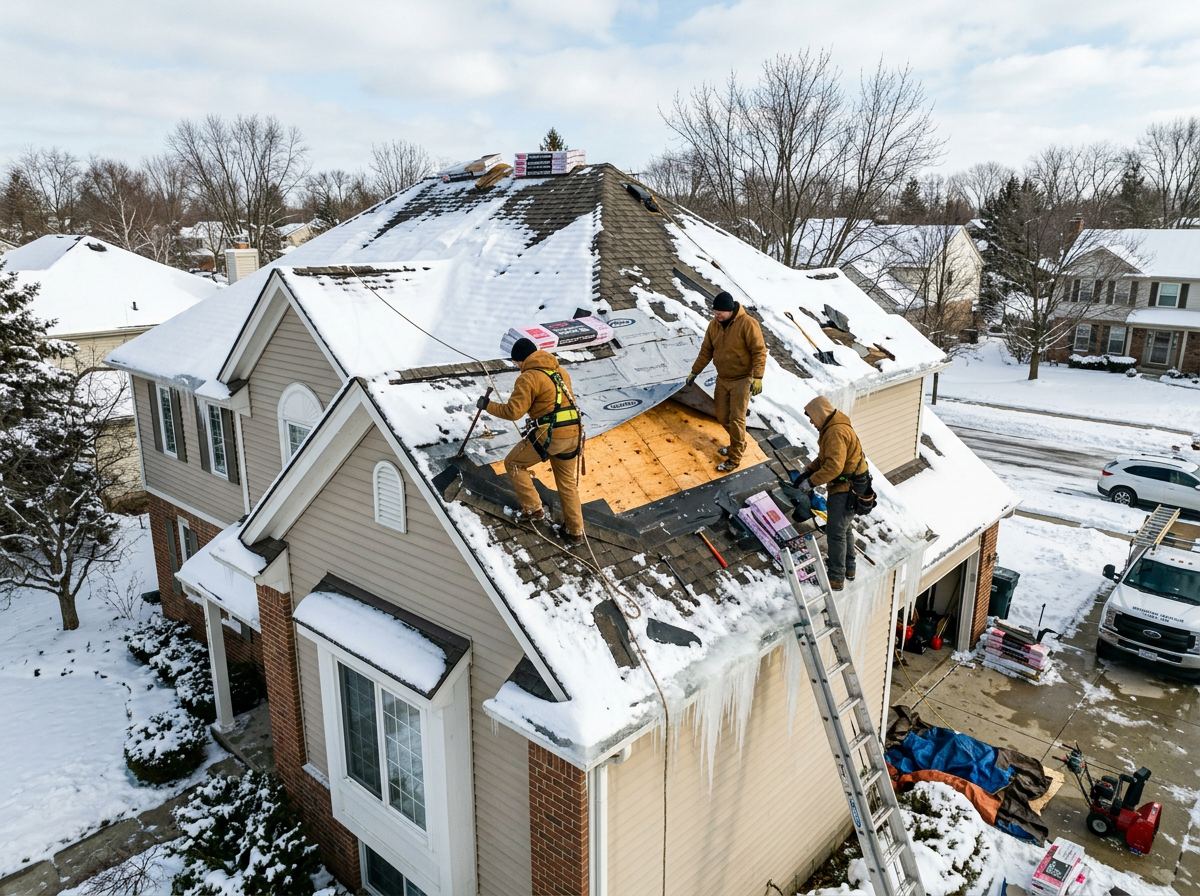
Ice dams form when heat escapes through attic spaces in Troy colonials and ranches built between the 1960s and 1990s, melting snow that refreezes at the eaves. Freeze-thaw cycles combined with wind and hail push water under curling shingles and granule-loss areas, especially along valleys and step flashing on homes near the Rochester Road Corridor and Big Beaver. Mature trees around subdivisions drop debris into gutters and valleys, blocking soffit intake and ridge vent airflow and turning minor leaks into decking rot.
We start with a hands-on inspection from the attic and roof surface, checking for soft decking, failed pipe boots, and inadequate underlayment near the drip edge. Tear-off removes compromised layers so new ice and water shield can be applied in the lower six feet and critical valleys before architectural shingles go back down. Ridge vent and soffit intake upgrades restore balanced airflow on homes with HOA restrictions that limit visible changes.
Work focuses on southeast Oakland County properties where second or third roofs meet the same ice dam patterns year after year. Proper step flashing integration at chimneys and walls, combined with new underlayment and drip edge, stops water from backing up under wind-driven snow. Every repair leaves the decking exposed for direct inspection before new materials are installed.
Technician insight
In Troy, the thing that catches most people out with Ice Dam Damage Repair is how often the second or third asphalt roof on 1960s-1990s colonials has no ice and water shield at all. Mature trees along the Rochester Road Corridor drop leaves that block soffit intake for years, so even after we fix the dam the attic stays too warm. Homeowners usually think the leak is just a bad shingle until we open the decking and see how far the water traveled under the valleys.
Ice Dam Leak on a Rochester Road Colonial
Water appeared in an upstairs ceiling after a January freeze-thaw cycle. Inspection showed no underlayment at the eaves and blocked soffit vents from nearby oak trees. We performed a targeted tear-off, installed ice and water shield along the lower six feet, renewed step flashing, and cleared the intake vents. The ceiling was dry through the next winter.
Ice Dam Damage Repair Services We Offer
✓Ice Dam Assessment and Attic Inspection
Detailed review of ventilation, insulation levels, and existing underlayment to locate where heat loss creates dams on Troy roofs.
✓Tear-Off and Ice and Water Shield Replacement
Complete removal of damaged layers followed by new ice and water shield application along eaves and valleys to block future water intrusion.
✓Ridge Vent and Soffit Intake Restoration
Clearing blocked soffit vents and installing or repairing ridge vent sections to restore airflow on 1960s-1990s colonials and ranches.
✓Valley and Gutter Debris Removal
Cleaning mature-tree debris from valleys and gutters to prevent ice dam formation along roof edges in southeast Oakland County subdivisions.
✓Decking and Step Flashing Repair
Replacement of rotted decking sections and reinstallation of step flashing at walls and chimneys to stop leaks from wind-driven ice melt.
How it works
- 1
Site Assessment
We examine the roof surface, attic, and eaves to identify active ice dams, damaged underlayment, and ventilation shortfalls on the specific Troy home.
- 2
Tear-Off Preparation
Compromised shingles and underlayment are removed down to the decking so every affected area can be inspected before new materials are installed.
- 3
Shield and Flashing Work
Ice and water shield is laid in the lower roof sections and valleys, with step flashing and pipe boots renewed to create a continuous water barrier.
- 4
Ventilation and Finish
Ridge vent and soffit intake are restored or upgraded, followed by new architectural shingles matched to the existing roof.